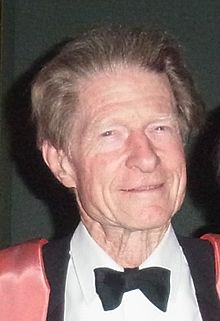
 The meeting in Colorado was really good. This was different from the one in California not just in location but also a little bit in focus. The one in California was about the whole muscle so there were talks about the tendons and the neuromuscular junction and the muscle fibers. The Colorado meeting was focused specifically on the muscle stem cells that are responsible for repairing the muscle after injury and a little bit of growth and maintenance. Because of the focus on stem cells we were able to have Sir John Gurdon as our keynote speaker. He won the Nobel prize in 2012 for his work on cell reprogramming. You might remember from biology class that if you take the nucleus out of a normal differentiated cell and put it in an egg or a stem cell it reprograms and becomes a stem cell. This is the approach they used to clone Dolly the Sheep. Incidentally, this is the 20 year anniversary of cloning Dolly. Scientific American did a pretty good summary of what progress has been made in those 20 years. The main connection to the rest of the conference is that the work in cell reprogramming is that Sir John Gurdon's work paved the was for induced pluripotent stem cell (iPSC) production and therapy. In this approach you take a normal cell from a patient, turn it into a stem cell, and give it back to the patient as a therapy. The keynote address focused on the challenges in doing this effeciently and the ways in which the iPSCs differ from non-induced stem cells. Several talks in the conference reported on clinical trials of iPSC or resident stem cell transfer. Some of the trials were fairly successful, like one study that treated a rare form of muscular dystrophy and saw functional improvement that lasted at least 2 years. Others were successful as a proof of principal for different cell types or different routes of administration but also highlighted the progress that still needs to be made for these therapies to be highly effective.
Another major theme of the meeting was the communication between the muscle stem cells and the other cells in the muscle. How do the stem cells know what to do and how do the other cells know if they have done it? Regeneration is a complex process that requires lots of different cell types to all work together. Some need to be active at the beginning others need to be active at the end. Many people are studying the coordination between all the cells and what happens when that coordination is interrupted.
 My poster was the same one that I presented in California. I got a lot of good feed back and some good ideas about what to try next. I also got to talk with many scientists about their work, all of which was very exciting. I talked with some of them about my interest in their lab for my post doctoral work. All of the ones I talked to were encouraging and are looking forward to seeing my paper when it gets published.
I will say though that one of the highlights of the meeting was the dance party the last night. One of the songs they played was the Bad Project Lady Gaga parody. I was thoroughly entertained by being on the dance floor with the most successful muscle stem cell scientists in the world and all their trainees, dancing to a ridiculous science song. Phenomenal.

I like the Lady Gaga parody. I imagine all grad students feel like that at least some of the time.
ReplyDelete